Let me start with something that might hit close to home for you right now. You hit your head, maybe from a fall on ice before your trip or a car accident on the way to the airport. Perhaps your heavy bag fell from the overhead bin and caught you right on the temple. In the moment, you shook it off because you had flights to catch and meetings to attend. But days later, something feels wrong and different in your body and mind. You cannot focus on your book the way you used to read before. Bright lights in the terminal feel like they are stabbing your eyes with pain. You feel foggy, irritable, and not quite like yourself at all anymore. This is the quiet, confusing reality of a concussion that no one warned you about. At our airport rehab centre, we understand exactly what you are going through right now.
What a Concussion Actually Is and Does to You
Let me clear up a common misunderstanding about head injuries right from the start. A concussion is not a bruise on your brain that you can see on a scan. You cannot see it on a standard CT scan or MRI, which makes it feel invisible. But the effects of a concussion are very real and very physical for your body. Think of your brain as soft jelly floating inside a hard shell, your skull. When your head stops suddenly, that jelly keeps moving and bumps against the walls. This impact stretches and damages millions of tiny brain cells in your head. Those cells then struggle to communicate with each other the way they normally do. Everything slows down, your processing, your balance, your memory, and your emotional control. This is why you feel foggy, clumsy, and irritable after a hit to your head.
Why Old Advice About Rest Was Wrong for Recovery
For a long time, the standard advice for a concussion was simple and easy to follow. Go home, lie in a dark room, and do nothing until you feel better again. We now know that this approach often does more harm than good for your recovery. Complete rest for more than a day or two can actually slow your healing down significantly. Your brain needs gentle, graded stimulation to rebuild its damaged pathways over time. It needs movement, within a safe window that does not flare your symptoms up. It needs visual challenges that retrain your eye tracking and focus after the injury. Also it needs physical activity that slowly increases your heart rate without making your headache worse. This is the gap our airport rehab centre fills for travelers like you every day. We do not just tell you to rest, we give you a structured plan to guide you back to clarity.
The Symptoms You Might Not Connect to Your Head Injury
Here is the tricky part about concussions that makes them so hard to diagnose. They do not always announce themselves with dramatic signs like passing out or vomiting. You might not lose consciousness or even remember hitting your head at all. The symptoms often creep in slowly, hours or days later, without you noticing the pattern. You might notice that you are more irritable with your family for no clear reason. Reading a menu or your phone screen might suddenly give you a pounding headache. The busy airport environment might feel overwhelming in a way it never did before. You might feel dizzy when you turn your head quickly to check your gate number. These are all classic signs of a brain struggling to process information after an injury. Our team at the airport rehab centre is trained to spot these connections and help you understand them.
What Your First Visit Looks Like at Our Centre
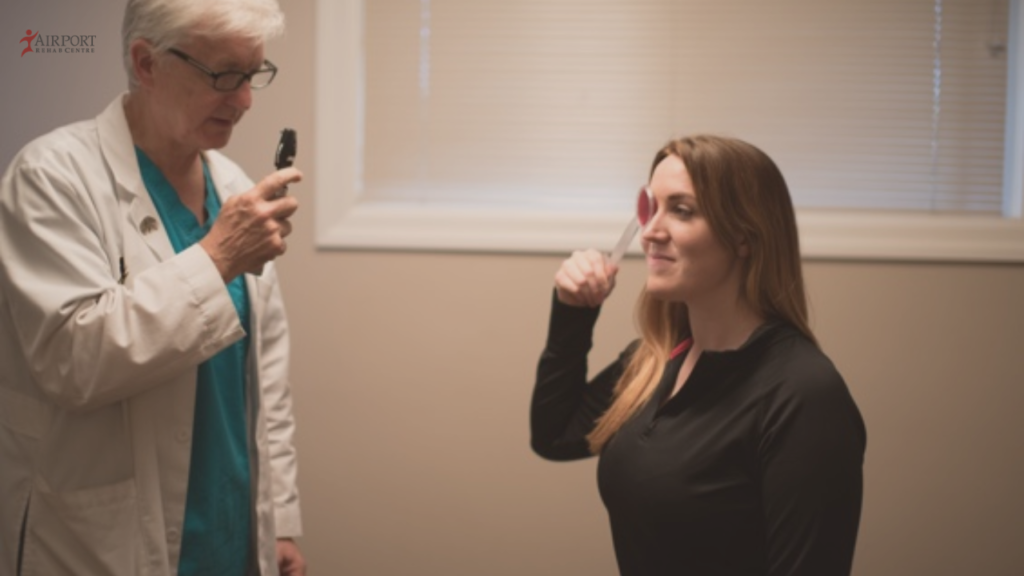
Walking into our clinic after a head injury can feel strange because you look fine on the outside. You might worry that we will not believe how bad you feel inside your head. Let me put that fear to rest right now before you walk through our door. Your first visit is a conversation, not a judgment about what happened to you. We ask about what happened, how you felt right after, and how you feel now. We ask about your sleep, your mood, and your ability to focus at work. Also we ask about your sensitivity to light, sound, and movement during your day. Then we move through a series of simple, careful tests to understand your brain. We watch your eyes track a moving pen and check your balance on different surfaces. By the end, we have a clear picture of where your brain is struggling.
The Emotional Side of Brain Recovery with Concussion Management
Nobody talks enough about how lonely a concussion can feel for the person going through it. You look fine, so people forget that you are injured and need extra patience. They expect you to be yourself, but you do not feel like yourself at all. You might cry easily or snap at loved ones without meaning to hurt them. You might feel anxious in situations that never bothered you before the injury. Also you might worry that you will never feel normal again, which is a scary thought. This is not a character flaw, it is a brain injury affecting your emotions. Part of our role at the airport rehab centre is simply to validate this experience for you. We tell you that what you are feeling is normal and expected for a brain that is healing.
Your Path Back to the Person You Remember Being
The road out of a concussion is not always a straight line that goes smoothly uphill. You will have good days when you feel almost back to your normal self. You will have bad days when the fog rolls back in and scares you again. This is normal, this is healing, and this is not a sign that you are broken. It is a sign that your brain is processing the trauma in its own time. The key is consistency, showing up for your sessions and doing your home exercises. Pacing your activities and resting when you need to rest is also very important. Over weeks and months, the good days start to outnumber the bad ones. The fog lifts, the headaches quiet, and the irritability fades away over time. You start to recognize yourself again, and that feeling is worth every step of this difficult journey back to health.