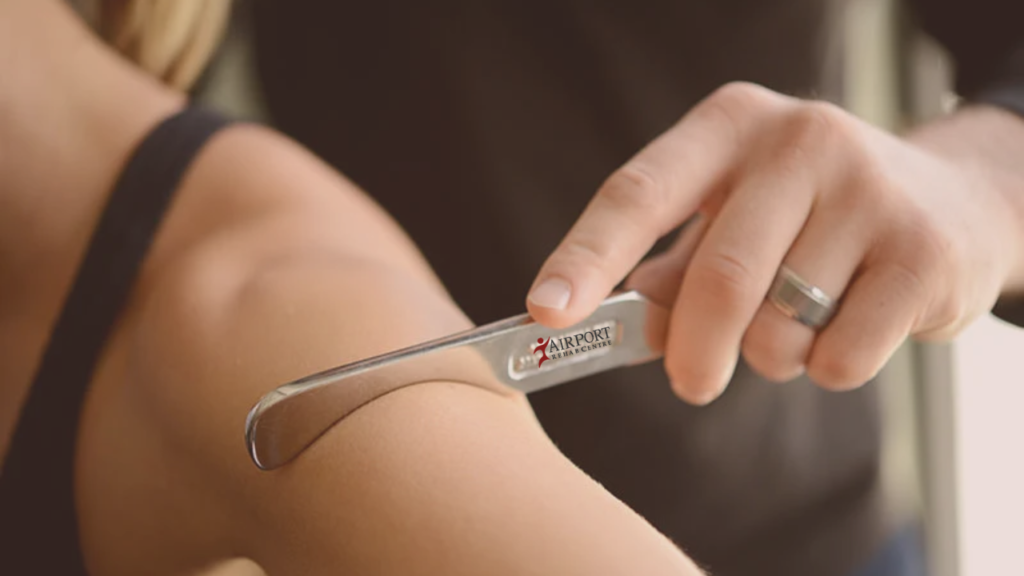
Let me tell you about a tool that changed how I think about soft tissue healing. You know that feeling when a muscle has been tight for so long it just feels like a permanent knot? You press on it, roll it out, stretch it, and maybe even beg someone to dig their elbow into it. But something always feels stuck underneath, unreachable, like a rock buried deep in clay. This is where the Graston Technique enters the story. It is not magic, though it can feel that way the first time you experience it. It is a set of stainless steel instruments, carefully shaped to glide over your skin and find what human hands simply cannot feel. At our airport rehab centre, we use this technique for travelers who carry old injuries, tight fascia, and stubborn scar tissue through the terminal. The tools become an extension of our hands, helping us see beneath the surface of your skin.
What the Tools Actually Do
Let me walk you through how this works because it is genuinely fascinating. The Graston instruments are six different stainless steel tools, each shaped for a specific part of the body. They have curved edges, some concave and some convex, designed to fit the natural contours of your muscles and joints. When a trained therapist runs these tools over your skin with a small amount of gel, something remarkable happens. The instruments act like a stethoscope for scar tissue deep beneath the surface. They resonate in the therapist’s hands, transmitting vibrations that the human touch alone cannot feel. When the tool hits a restriction, a knot, or an area of old adhesion, both the therapist and you can sense it. It feels like a bump, a drag, a rough patch beneath the skin. Once found, the therapist uses specific strokes to treat that spot. The goal is to break up the fibrous tissue that has been limiting your movement and causing your pain. It is precise, targeted, and unlike anything you have felt before.
The Conditions That Respond to This Care
The list of problems that improve with Graston Technique is long and varied. Plantar fasciitis, that stabbing heel pain that makes every step through the airport a misery, responds beautifully to this approach. Achilles tendinopathy, whether from running or just years of normal wear, often softens after just a few sessions. Tennis elbow and golfer’s elbow, those stubborn tendon pains near the joint that never seem to heal, are common candidates. Carpal tunnel syndrome, with its tingling and numbness in the hands, can improve as the technique frees up the soft tissue around the median nerve. Neck pain from old whiplash, back pain that has lingered for years, and shoulder stiffness from rotator cuff issues all fall within its reach. At our airport rehab centre, we also use it for post-surgical scars, even from C-sections or mastectomies, to help the tissue heal more smoothly and move better. Shin splints, IT band tightness, and even some symptoms of fibromyalgia have shown improvement in many patients. The technique is versatile because it addresses a universal problem, tissue that has lost its ability to move freely.
The Science Behind the Sensation
Let me share a little about why this works, because knowing the “why” helps you trust the process. When soft tissue gets injured, whether from a single traumatic event or years of repetitive strain, the body lays down scar tissue to stabilize the area. This is natural and necessary in the short term. But scar tissue is not the same as healthy tissue. It is less organized, less flexible, and less strong than what was there before. Over time, it can mat down, entrap small nerves, and restrict movement in ways that become permanent if not addressed. The Graston Technique applies controlled force through the instruments to break up this disorganized tissue. This creates a microtrauma, a very small and intentional injury, that prompts the body to restart its healing process. Fresh blood rushes into the area. Fibroblasts, the cells that build healthy tissue, become more active. New collagen forms in a more organized, functional pattern. It is like giving your body a second chance to heal something it healed poorly the first time. At our airport rehab centre, we pair this with specific exercises to guide that new tissue into strong, functional alignment.
What Comes After the Tools
Here is the part that matters most for your long-term results. The instrument work is only half the story, maybe even less than half. What you do after the session determines how lasting your results will be. Your therapist will give you specific stretches and strengthening moves to perform at home between visits. These are not optional extras. They are the blueprint your body follows to rebuild itself correctly after the tools have done their work. The Graston Technique opens the door, but you have to walk through it. Drinking plenty of water in the hours after treatment is also crucial. Your body is clearing out metabolic waste from the broken-up tissue, and water helps flush that system out efficiently. You might feel sore for a day or two, like you did a deep workout in that specific area. This fades, and what replaces it is a feeling of ease, of movement that used to require effort now flowing naturally. The team at our airport rehab centre will guide you through every step, from the first tool stroke to the final home exercise. We are in this together, with you.
The Quiet Confidence of Finally Healing
I have sat in that treatment chair myself, feeling those tools work through layers of tissue I did not even know were tight. There is a strange relief in finally having someone find the spots you could never reach on your own. It is like your whole body exhales after holding its breath for years. The Graston technique is not for everyone, and your therapist will always do a full assessment first to ensure it is right for your specific condition. But for the right person, with the right problem, it can be nothing short of transformative. At our airport rehab centre, we have watched people walk in hunched and guarded and walk out standing tall and relaxed. We have seen chronic pain that traveled for years finally settle down. The tools are just metal. But in skilled hands, guided by training and real care, they become something more. They become a path back to the body you remember, the one that moved without thinking, without wincing, without fear. That path is open to you whenever you are ready to take the first step.