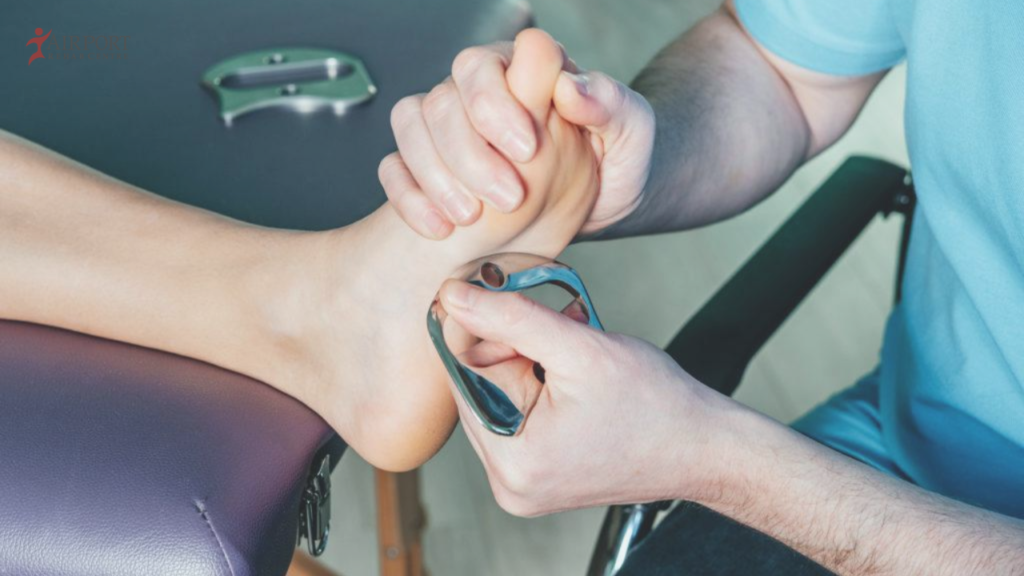
Let me tell you about a tool that changed how I think about soft tissue healing. You know that feeling when a muscle has been tight for so long it feels like a permanent knot? You press on it, roll it out, and stretch it every single day. Maybe you have even begged someone to dig their elbow into that spot. But something always feels stuck underneath, unreachable, like a rock buried deep in clay. This is where the Graston Technique enters the story to help you. It is not magic, though it can feel that way the first time you try it. It is a set of stainless steel instruments shaped to glide over your skin. These tools find what human hands simply cannot feel beneath the surface. At our airport rehab centre, we use this technique for travelers who carry old injuries and stubborn scar tissue through the terminal every day.
Where Did This Strange Technique Actually Come From?
Every good tool has a story, and the Graston Technique starts with a frustrated athlete. David Graston was a competitive water skier who hurt his knee badly. He needed surgery, but his recovery stalled despite doing everything his doctors told him. He grew tired of waiting and wondering if he would ever feel like himself again. So he did something bold and took matters into his own hands. He started crafting metal instruments in his own machine shop at home. He shaped them to reach his own tight tissues in ways his hands could not. The results were so striking that medical researchers took serious notice of his work. They studied what he had created and found real promise for many different conditions. By 1994, the first certified Graston clinic opened its doors to the public. That same technique now helps travelers passing through our airport rehab centre find relief from pains they thought were permanent.
What Conditions Respond Best to This Type of Treatment?
The list of problems that improve with Graston Technique is long and varied for different people. Plantar fasciitis, that stabbing heel pain that makes every step through the airport a misery, responds beautifully. Achilles tendinopathy, whether from running or just years of normal wear, often softens after a few sessions. Tennis elbow and golfer’s elbow, those stubborn tendon pains near the joint that never seem to heal, are common candidates. Carpal tunnel syndrome, with its tingling and numbness in your hands, can improve as the technique frees up soft tissue around the nerve. Neck pain from old whiplash, back pain that has lingered for years, and shoulder stiffness from rotator cuff issues all fall within its reach. At our airport rehab centre, we also use it for post surgical scars to help the tissue heal more smoothly. Shin splints, IT band tightness, and even some symptoms of fibromyalgia have shown improvement with this care. The technique is versatile because it addresses a universal problem, tissue that has lost its ability to move freely on its own.
What Does a Graston Session Actually Feel Like for You?
I want you to picture this clearly so nothing feels like a surprise on your first visit. You will come into our quiet room at the airport rehab centre and settle onto a padded table. Your therapist will apply a small amount of lotion or gel to your skin to help everything glide smoothly. Then the tool touches your skin for the first time, and you will feel something different. The sensation is hard to describe because it is unlike typical massage at all. It is deeper, more specific, like someone is finally reaching the exact spot that has bothered you for months. You might feel a mild scraping or catching sensation when the tool hits a restricted area. This is not sharp pain exactly, but it is definitely a strong sensation you will notice. Your therapist will check in with you constantly, adjusting pressure based on your feedback. After the treatment, you might notice the area feels warm, almost like a sun kissed heat from the inside out. This is good, it means blood is flooding into tissues that have been starved of good circulation for far too long.
What Should You Expect to Feel After Your Session Ends?
The real work continues after you leave our clinic and go about your normal day. Your therapist will give you specific stretches and strengthening moves to perform at home between visits. These are not optional extras, they are the blueprint your body follows to rebuild itself correctly. The Graston Technique opens the door to healing, but you have to walk through it with your home exercises. Drinking plenty of water in the hours after treatment is also very important for your recovery. Your body is clearing out metabolic waste from the broken up tissue, and water helps flush that system out. You might feel sore for a day or two, like you did a deep workout in that specific area. This fades, and what replaces it is a feeling of ease in your body. Movement that used to require effort now flows naturally without you thinking about it. The team at our airport rehab centre will guide you through every step from the first tool stroke to the final home exercise.
Why Do Travelers Find This Technique Especially Helpful?
If you move through airports regularly, you already know what your body carries after each trip. The heavy bags, the rushed connections, and the long periods of sitting in cramped seats. All of it lands in your soft tissue, adding up slowly with every journey you take. Old injuries that have been quiet for months can suddenly flare after a single long flight. Shoulders that guard themselves from years of laptop bags get tighter and tighter over time. The Graston Technique is uniquely suited for this traveling population because it gets results relatively quickly. You do not need weeks and weeks of buildup to feel a real difference in your body. Many travelers notice improvement after just two or three sessions spaced a week apart. This matters when your time between flights is limited and very precious to you. A quick visit to our airport rehab centre can undo the damage of your last trip and prepare you for the next one. You walk out feeling physically different, lighter, and more available to your own body without pain holding you back.