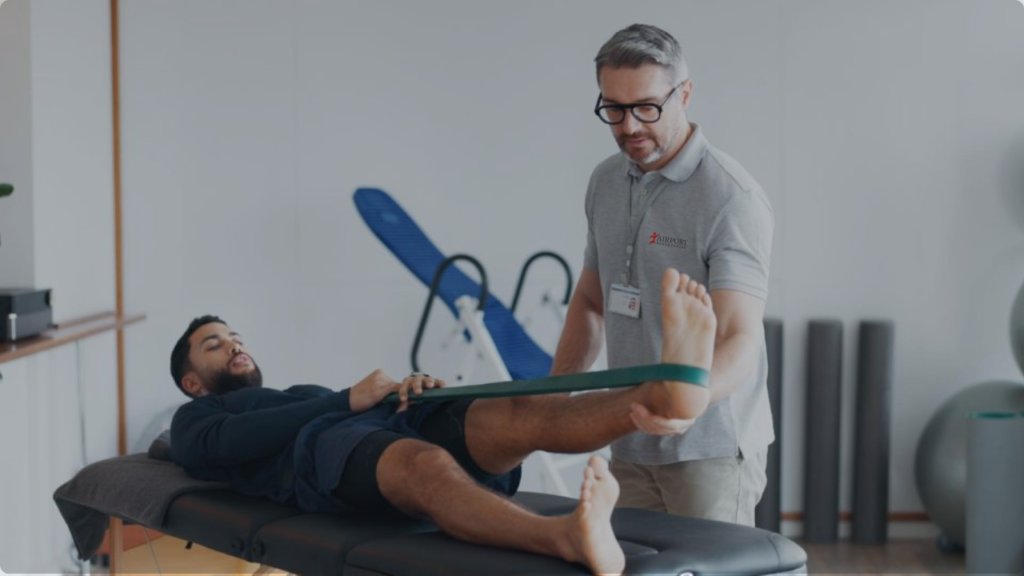
Let me start with something that might hit close to home. You were in a car accident. Maybe it happened last week, maybe last month, maybe even last year. In the moment, you felt the shock, the jolt, the sudden stop. You walked away, maybe with some stiffness, but you told yourself you were fine. That is what most of us do. We shake it off and keep moving because life does not pause for us to catch our breath. But weeks later, something still feels off. Your neck aches when you turn to check your blind spot. Your back stiffens up after a short flight. You wake up feeling like you slept wrong, except you sleep that way every night now. This is the quiet aftermath of a motor vehicle accident. Many injuries do not show up right away, and that is where MVA physiotherapy can help. It focuses on treating injuries caused by car accidents, helping reduce pain, restore movement, and support proper healing. At our airport rehab centre, we see this every day in travelers who thought they escaped without a scratch.
Why MVA Physiotherapy Is Different from Regular Physiotherapy
You might wonder why a car accident deserves its own special category of care. The answer lies in how crashes injure the body. A fall or a sports twist usually involves one direction of force. You land wrong, you twist too far, you feel it immediately. But a car accident throws your body in multiple directions at once. You brace against the steering wheel while your head snaps forward and back. Your shoulders tighten, your jaw clenches, your lower back locks up in protection mode. This happens in a split second, but the effects can last for months or years. MVA physiotherapy is built specifically for this chaos. It understands that whiplash is not just a neck problem. But it involves the jaw, the upper back, even the nerves running down your arms. It knows that seatbelt injuries are not just surface bruises. They can affect your ribs, your shoulders, your breathing. Regular physiotherapy might miss these connections. MVA physiotherapy is trained to see the whole picture.
The Hidden Injuries You Might Not Know You Have
Here is the tricky part about car accidents. The injuries that hurt most later are often the ones you did not feel at first. Adrenaline is a powerful drug. It floods your system in the moment of impact, masking pain that would normally stop you in your tracks. You walk away from the scene, exchange information, maybe even drive yourself home. You think you are lucky. But that adrenaline eventually wears off, usually within a day or two. Then the real story begins to surface. Whiplash, the most common MVA injury, often takes hours or days to fully announce itself. That headache that started as a dull throb becomes a daily companion. Also the tingling in your fingers, the one you dismissed as sleeping wrong, persists. Your jaw starts clicking when you chew. Your vision gets weird in bright light. None of this is in your head. But all is connected to the crash. At our airport rehab centre, we are trained to find these hidden connections. We ask about your sleep, your mood, your concentration. Also we check your jaw, your neck, your upper back as one unit. It means we look for the patterns that tell the real story of your crash.
What Happens to Your Body in a Crash
Let me walk you through the physics of a car accident so you understand why your body feels the way it does. When your vehicle stops suddenly, your body keeps moving at the original speed. Your seatbelt catches you, which saves your life, but that force has to go somewhere. It drives into your pelvis, your ribs, your shoulder. Meanwhile, your head, which is heavy and not strapped down, continues forward until your neck catches it. Then it whips back, often hitting the headrest. This all happens in a fraction of a second, but the tissues involved take months to heal. Muscles that stretched too far develop micro-tears. Ligaments that held on too tight become lax. Nerves that got compressed start sending confused signals. Even your brain, sloshing inside your skull, can sustain injury that affects your balance, your focus, your emotional control. MVA physiotherapy at our airport rehab centre addresses all of this. We do not just treat your sore neck. We treat the whole system that was disrupted in that single, violent moment.
The Emotional Toll That Lives in Your Tissues
Nobody talks enough about the emotional weight of a car accident. You might find yourself gripping the wheel tighter now when you drive. Also you might flinch at sudden stops or feel your heart race when traffic stacks up. This is not weakness. This is your nervous system doing its job, trying to keep you safe by staying on high alert. The problem is that a nervous system stuck in high alert keeps your muscles guarded. Guarded muscles stay tight. Tight muscles pull on joints and restrict movement. Pain follows. This is why MVA physiotherapy at our airport rehab centre includes more than just physical treatment. We talk about your experience of the crash. We help you understand why your body is reacting the way it is. And we teach you strategies to calm your nervous system, to tell it that the danger has passed. This mind-body connection is not optional. It is essential to full recovery.
What Your First Visit Looks Like
Walking into our clinic after an accident can feel strange. You look fine on the outside, but inside you know something is wrong. Your first visit is a safe place to let that out. We start with questions, lots of them. Tell us about the crash. Which way were you facing? Did you see it coming? How did you feel right after? How do you feel now? We watch you walk, turn your head, reach your arms. We feel for tight spots, tender areas, places where your body is holding onto the crash. Also we check your neck, your jaw, your upper back, your lower back. We look at your balance and your eye movements. By the end, we have a map. A clear picture of what the crash did to you and a plan for how to fix it.
The Road Ahead
You cannot undo the crash. You cannot go back to the moment before impact and choose a different path. But you can choose what happens next. You can choose to seek help, to understand what your body is telling you, to invest in your own recovery. MVA physiotherapy is not about erasing what happened. It is about reclaiming what comes after. Your life, your movement, your comfort, your confidence. These things are still yours. They may feel buried right now, buried under pain and fear and frustration. But they are there, waiting. Our job at the airport rehab centre is to help you find them again. We bring the tools, the training, and the steady presence. And you bring your willingness to heal. Together, we walk the road ahead, one step at a time, until the rearview mirror shows only distance between you and that day.